

Table of Contents
The Only 2 Lenses You Need for Travel Storytelling (16mm & 85mm Guide)
16mm and 85mm Travel Storytelling: If you look inside the camera bag of a beginner travel vlogger, you will likely find a massive 24-70mm f/2.8 zoom lens. It is the “safe” choice, designed to capture absolutely everything without the photographer ever having to take a step forward or backward. But safety rarely creates cinematic art.
Heavy zoom lenses often lead to a lazy, static filmmaking style. Instead of moving your body to find the perfect angle or perspective, you simply twist the lens barrel. You let the glass do the work, which inherently makes the footage feel less dynamic and less intentional.
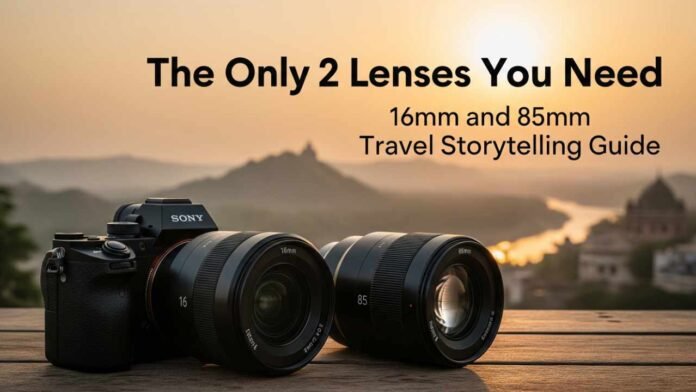
At Pankaj Sharma Films, my philosophy relies on intentional, minimalist gear. I shoot 90% of my documentaries using a strict two-lens prime kit: the Viltrox 16mm f/1.8 and the Sony 85mm f/1.8.
This extreme focal length gap forces creativity. It demands the “sneaker zoom”, meaning you have to physically walk closer to your subject or step deeper into the landscape to get the shot. This physical interaction with your environment yields a high-end, immersive commercial look that standard zooms simply cannot replicate. Using the 5W1H method, here is the complete breakdown of why mastering 16mm and 85mm travel storytelling is the ultimate strategy for solo filmmakers.
WHO is this Setup For?
This two-lens prime setup is not for the run-and-gun news shooter who needs to capture every single event at exactly eye level. It is not for the creator who is terrified of missing a shot while changing lenses.
This kit is designed specifically for the cinematic documentarian and the agile solo filmmaker. It is for creators who realize that omitting visual information is just as powerful as including it, prioritizing a distinct, deliberate visual style, extreme scale, and intimate emotion—over the pure convenience of a zoom. Furthermore, it is a physical revelation for any filmmaker trekking through the Himalayas or walking 15 kilometers a day through crowded cities. Saving hundreds of grams of glass in your backpack directly translates to longer shooting endurance and less creative fatigue. If you want your travel films to look like high-budget movies rather than shaky home videos, this is your setup.
WHAT is the 16mm & 85mm Philosophy?
Cinematic storytelling relies on a psychological rhythm of establishing the world and then showing how human beings exist within it. This specific two-lens kit perfectly mirrors that exact rhythm.
The World Builder (Viltrox 16mm f/1.8): This is your context lens. An ultra-wide 16mm on a full-frame sensor doesn’t just show a location; it forces the viewer into the environment. It pulls the viewer forward, exaggerating perspective. When you place a subject close to the glass, it makes the foreground dominant while still showcasing the towering, imposing architecture or the vast, endless skies behind it. It is the ultimate “you are here” focal length.
The Soul Seeker (Sony 85mm f/1.8): This is your emotion lens. Where the 16mm includes everything, the 85mm isolates. It is a psychological tool that completely separates your subject from the chaos of their environment. It provides intense background compression, an optical illusion that makes distant mountains or backgrounds look massive and pulled directly behind your subject. It strips away the visual clutter of the world, telling the viewer’s eye exactly where to focus.
WHY Ditch the Zoom Lens? (The f/1.8 Advantage)
Why carry two separate prime lenses when a versatile 16-35mm or 24-70mm zoom exists? The answer comes down to two critical cinematic pillars: light gathering and subject separation.
Most standard travel zoom lenses are f/4 or, at their most expensive, f/2.8. Both the Viltrox 16mm and Sony 85mm open up significantly wider to a massive f/1.8 aperture.
Low Light Dominance: In the dimly lit interior of an ancient stone temple, or during the fleeting blue hour after sunset, an f/1.8 lens lets in over twice as much light as an f/2.8 zoom. When shooting in S-Log3 on the A7C II, maintaining your base ISO is crucial for a clean, noise-free image with maximum dynamic range. This aperture ensures you don’t have to artificially crank your ISO into the noisy, muddy mid-ranges just because the sun went down.
Subject Separation: India is visually loud and chaotic. A 24-70mm at f/2.8 often leaves the background just sharp enough to be highly distracting. An 85mm prime shot wide open at f/1.8 obliterates that distraction. It turns neon signs, chaotic traffic, or crowded markets into beautiful, abstract orbs of light (bokeh), instantly elevating the production value.
WHERE & WHEN: Real-World Scenarios
Here is how the 16mm and 85mm travel storytelling dynamic works in the field during a typical, fast-paced Indian expedition:
Scenario A: The Varanasi Ghats at Dawn
When to use the 16mm: It is 5:30 AM. You are on a small, rocking wooden boat on the Ganges. You use the 16mm to capture the sweeping, ultra-wide establishment shot of the entire riverbank. The wide field of view captures the rising sun, the smoke drifting from the cremation ghats, and the massive, intimidating scale of the ancient architecture reflecting on the water.
When to switch to the 85mm: Once the world is established, you pull out the 85mm to punch in on the human element. You focus tightly on the weathered, lined face of your boatman rowing, capturing the effort in his eyes. The 85mm completely isolates his expression against the beautifully blurred, sparkling golden water behind him, turning a simple boat ride into an emotional portrait.
Scenario B: The Crowded Spice Market in Rajasthan
When to use the 16mm: You mount the camera on a gimbal and walk directly through the narrow, chaotic alleyway. The 16mm captures the vibrant, towering mounds of spices on both sides of the frame. Because it is so wide, it keeps you (the filmmaker) perfectly in frame for a dynamic POV or vlogging shot without awkwardly cropping off your head or shoulders.
When to switch to the 85mm: You step back, stand across the street, and shoot through the bustling crowd with the 85mm. The extreme focal compression blurs the people quickly walking in the foreground, creating a sense of bustling motion, while keeping perfect, razor-sharp focus on the spice vendor pouring turmeric in the background.
HOW to Maximize This on the Sony A7C II (The Super 35 Hack)
This is where this specific kit goes from simply “great” to absolute “genius.” The Sony A7C II features a high-resolution 33-megapixel sensor with a highly detailed, built-in Super 35 (APS-C) mode.
Because the sensor is so incredibly resolute, turning on Super 35 mode applies a 1.5x digital crop to the center of your image while still delivering flawless, oversampled 4K 10-bit video. You don’t lose any perceptible sharpness. By mapping this feature to a custom button (like C1 or the Trash button), you effectively turn your 2 lenses into 4 distinct focal lengths in less than a second, without exposing your sensor to dust by changing glass:
Native 16mm: Ultra-wide establishing shots and gimbal movements.
Super 35 Mode (16mm becomes 24mm): The 24mm equivalent is the gold standard of cinema. It is the perfect, natural-looking focal length for documentary storytelling and hand-held vlogging.
Native 85mm: Standard portraiture, interviews, and medium-tight cinematic shots.
Super 35 Mode (85mm becomes ~128mm): You suddenly have a massive telephoto lens! A 128mm equivalent f/1.8 lens provides god-tier background compression for capturing skittish wildlife, pulling distant Himalayan peaks closer, or capturing extreme, macro-style details of local street food sizzling in a pan.
The 4K 60fps Secret Weapon
There is one more technical reality of the Sony A7C II that makes this duo indispensable: When you shoot slow-motion 4K at 60 frames per second, the camera processor physically forces a 1.5x Super 35 crop.
Think about the math: if your widest lens was a standard 24mm prime or a 24-70mm zoom, switching to slow motion would instantly crop you into a 36mm equivalent. That is far too tight to comfortably vlog, walk through a crowd, or hold the camera yourself without a massive tripod. Because you own the Viltrox 16mm, when you switch into 4K 60fps slow motion, your camera crops perfectly into a highly usable 24mm. The 16mm is practically the only way to shoot wide-angle, immersive slow motion on the A7C II!
Final Thought
Mastering 16mm and 85mm travel storytelling forces you to stop relying on the lazy twist of a zoom ring and start relying on your creative vision. It demands that you think about your shots before you hit record. It keeps your camera bag incredibly light, completely protects your image quality in low light, and, thanks to the Sony A7C II’s intelligent Super 35 mode, gives you every focal length you could possibly need to shoot a professional, world-class documentary.
YouTube: Watch more on my YouTube channel, Pankaj Sharma Films
Instagram: Follow Pankaj Sharma Films
Gear List: Check out my complete Minimalist Camera Packing List for 2026 to see how I securely pack these lenses on the road.
To see the cinematic results of this exact two-lens strategy in action, watch our latest travel documentaries over at Sapna Sharma Films.



