
Table of Contents
The Art of B-Roll Sequence Storyboarding: Open your video editing timeline right now. Look honestly at your raw footage bins. If your project is filled with fifty disconnected, 10-second clips of slow-motion leaves blowing in the wind, random people walking across the street, and endless panning shots of buildings without a clear subject—you have fallen into the biggest, most exhausting trap in travel filmmaking: “Spray and Pray.”
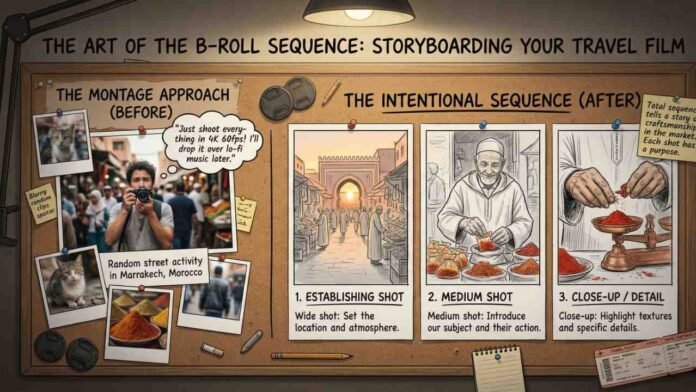
Many beginner creators think “B-Roll” simply means throwing the camera into 4K 60fps, pointing it at anything that moves, and later dropping those clips over a lo-fi electronic music track. But random clips, no matter how high the resolution, do not make a cinematic film. They make a montage. A true cinematographer does not shoot random clips; they intentionally shoot sequences.
At Pankaj Sharma Films, my entire documentary workflow and my sanity in the editing room rely entirely on in-the-field storyboarding. By applying the 5W1H Method (Who, What, When, Where, Why, and How) to your B-roll, you can transform your travel videos from chaotic amateur vlogs into high-end, immersive cinematic documentaries. Here is exactly how to train your brain to do it.
WHAT is a B-Roll Sequence?
A B-Roll sequence is a series of intentionally captured, visually connected shots that tell a complete “micro-story” without relying on a single word of spoken dialogue.
Instead of showing one lazy, 10-second wide shot of a bustling market, a sequence breaks that specific market down into multiple angles, focal lengths, and depths of field. Think about the psychology of human vision: when you walk into a new room, you don’t just stare blankly at the far wall. You look at the whole room (Wide), you spot a person of interest (Medium), and then you notice the coffee cup in their hand (Tight). A cinematic B-Roll sequence deliberately mimics how the human brain naturally processes and explores a new environment. It provides context, establishes action, and highlights intimate detail.
WHY Should You Storyboard in the Field?
The term “storyboarding” usually implies drawing stick figures on paper in a studio weeks before a Hollywood shoot. In dynamic travel documentary filmmaking, field storyboarding happens rapidly in your head just seconds before you hit the record button.
The Editing Advantage (Rhythm and Pacing): Shooting in intentional sequences cuts your post-production time in half. Instead of spending hours scrubbing through useless clips trying to force two unrelated shots to match, your edits will literally “cut themselves.” A wide shot naturally begs to cut to a medium shot, which naturally begs to cut to a tight detail. The rhythm is built into the footage.
Massive Storage Efficiency: The “Spray and Pray” method results in filling up expensive 2TB SSDs with gigabytes of unusable data. Instead of recording 200 random clips that you have to painfully review and delete, storyboarding allows you to shoot 25 highly intentional, precisely composed clips that you will actually drop onto your timeline.
Profound Emotional Depth: Sequences build narrative tension and environmental atmosphere. By showing a subject from multiple, connected perspectives, you build viewer empathy and connect the audience to the destination far better than a jarring, speed-ramped montage of unrelated tourist locations.
WHO is This “Art of B-Roll Sequence Storyboarding” Technique For?
This strategy is not for the viral “content creator” trying to pump out three hyper-active Reels a day. This technique is specifically for the solo filmmaker, the travel documentarian, and the creator who is ready to step away from the chaotic, transition-heavy viral trends. It is for the cinematographer who wants to practice the art of Slow Travel, using professional tools to craft high-end, timeless visual assets that tourism boards, heritage properties, and luxury brands actually pay for.
WHEN & WHERE: Real-World Scenarios in India
Let’s apply the art of B-Roll sequence & storyboarding directly to the chaotic, sensory-overload environment of India. How do you shoot a structured sequence when you absolutely cannot control the crowds, the lighting, or the environment?
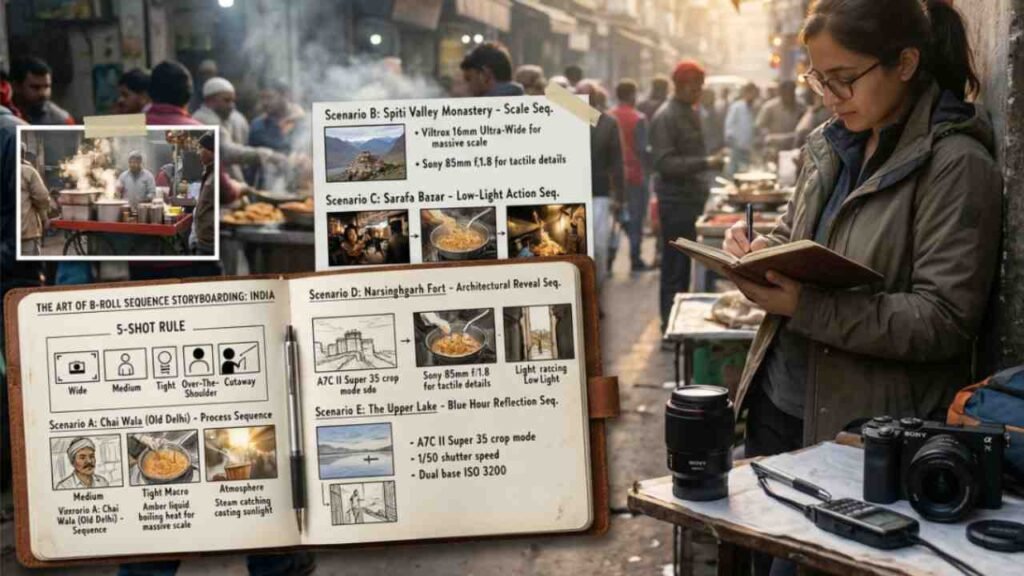
Scenario A: The Chai Wala in Old Delhi (A Process Sequence)
You are walking through Chandni Chowk and find a vendor making morning masala chai. A beginner shoots one wide shot of the cart from the street and walks away. A cinematographer stops, analyses the light, and shoots a structured process sequence.
The “Where” (Wide): The bustling, narrow alleyway with the weathered chai cart framed neatly on the left third of the screen, showing the early morning foot traffic passing by.
The “Who” (Medium): The vendor’s face. He is focused, eyes squinting slightly against the smoke, his skin warmly illuminated by the orange glow of the gas fire.
The “What” (Tight): An extreme macro shot of the amber liquid and spices rapidly boiling over the edge of the blackened aluminium pot.
The “When” (Atmosphere): The thick, aromatic steam rising and catching the harsh, golden morning sunlight piercing through the alleyway canopy.
Scenario B: The Spiti Valley Monastery (A Scale Sequence)
You have driven for days and are finally standing in front of a 1000-year-old Buddhist monastery perched on a cliff.
The “Where” (Ultra-Wide): Shot on a Viltrox 16mm lens. You frame the massive, barren valley, intentionally making the monastery look tiny against the towering, jagged Himalayan mountains to establish a profound sense of isolation and scale.
The “Who” (Medium): A monk draped in crimson robes slowly walking up the steep, uneven stone steps, his back to the camera.
The “Why” (Tight Detail): The worn, beautifully painted texture of the ancient copper prayer wheels spinning rapidly, blurred slightly by a 1/50 shutter speed.
The “How” (Cutaway): A shot looking straight up into the oxygen-deprived air, capturing colourful prayer flags fluttering violently against a deep, cloudless blue sky.
Scenario C: Sarafa Bazar, Indore (A Low-Light Action Sequence)
It is midnight in India’s most famous night food market. The environment is dark, chaotic, and moving incredibly fast. A beginner relies on auto-settings and gets a blurry mess. I rely on my A7C II’s dual base ISO of 3200 and shoot an action sequence.
The “Where” (Wide): The glowing, neon-lit street is packed shoulder-to-shoulder with people, thick smoke billowing from the stalls into the night sky.
The “Who” (Medium): A local chef tossing Bhutte Ka Kees high into the air, his face illuminated purely by the warm, practical tungsten light hanging above his cart.
The “What” (Tight Detail): Switch to 60fps. A macro shot of a heavy block of Amul butter hitting the massive iron Tawa (griddle) and instantly sizzling into golden foam.
The “Why” (Atmosphere): The mesmerised, hungry faces of the waiting crowd, caught in the soft glow of the fire.
Scenario D: Narsinghgarh Fort (An Architectural Reveal Sequence)
You are exploring the “Mini Kashmir” of Madhya Pradesh at dawn. The goal is to make the viewer feel the weight and history of the stone, moving beyond a simple wide shot of a building.
The “Where” (Wide): The imposing, weathered stone walls of the fort emerge mysteriously from the thick morning mist, framed by the lush green hills.
The “Who” (Medium): Your subject (or a local caretaker) slowly pushing open a massive, intricately carved wooden courtyard door.
The “What” (Tight Detail): Shot at f/1.8 on your 85mm. The heavy, rusted iron ring handle and the peeling, centuries-old texture of the wood underneath their hands.
The “When” (Cutaway): A single shaft of golden morning dust falling perfectly through a narrow stone archway, giving the location a spiritual, timeless atmosphere.
Scenario E: The Upper Lake, Bhopal (A Blue Hour Reflection Sequence)
It is 5:15 AM at the Bada Talab (Upper Lake). The world is painted in deep, moody blues. The goal here is pacing, allowing the sequence to breathe and utilising negative space.
The “Where” (Ultra-Wide): The vast, glass-like surface of the lake perfectly reflects the pre-dawn sky, with the silhouette of the city resting quietly in the distant third of the frame.
The “Who” (Medium): A lone fisherman casting a net from his wooden boat, his movement creating the only ripples in the entire frame.
The “How” (Over-The-Shoulder): Shooting past the fisherman’s shoulder, guiding the viewer’s eye precisely toward where the sun is just beginning to break the horizon.
The “What” (Tight Detail): Switch to 60fps. The dripping wet, wooden oars slowly breaking the surface tension of the water, the droplets catching the first light of day.
HOW to Execute: The “5-Shot Rule” In The Art of B-Roll Sequence & Storyboarding
To guarantee you have a complete, bulletproof sequence when you finally sit down in your editing bay, memorise the 5-Shot Rule. For every micro-story or subject you find, force yourself to stay planted. Do not leave the location until you have systematically captured these five specific angles.
(Note: To maintain a lightweight travel setup, I shoot all of these primarily using just the Viltrox 16mm and Sony 85mm f/1.8 primes, utilising the A7C II’s internal Super 35 crop mode to instantly change my focal lengths without swapping lenses in dusty environments.
Shot 1: The Wide (The Establishing Shot)
Goal: Anchor the viewer. Show them exactly where we are in the world and what the environmental context is.
Focal Length: 16mm to 24mm.
Technique: Keep the camera strictly locked off on a heavy tripod or hold your gimbal perfectly still. Do not pan. Let the organic motion of the city or nature happen entirely inside the static frame. Look for strong leading lines to guide the eye toward your subject.
Shot 2: The Medium (The Subject/Action)
Goal: Introduce the human element. Establish the main subject or the primary action happening within that wider space.
Focal Length: 35mm to 50mm.
Technique: Frame your subject from the waist up. Show their body language and how they are interacting with their immediate environment. Use the Rule of Thirds to give them “looking room.”
Shot 3: The Tight (The Details)
Goal: Engage the viewer’s tactile senses. Visual poetry. Show them the physical texture, the heat of a flame, the cold of ice, or the physical effort in a hand.
Focal Length: 85mm to 135mm (using Super 35 crop).
Technique: Focus purely on hands, eyes, tools, dirt under fingernails, or specific textures. Shoot this wide open at f/1.8 to completely isolate the detail, obliterate the distracting background, and tell the viewer exactly what is important.
Shot 4: The Over-The-Shoulder (POV)
Goal: Create a psychological anchor. Put the viewer directly in the shoes of the subject to see the world from their perspective.
Focal Length: 24mm or 35mm.
Technique: Stand just behind your subject and shoot past their shoulder to see exactly what their hands are working on or what landscape they are looking at.
Shot 5: The Cutaway (The Editor’s Lifeline)
Goal: Give your editor (usually you) a “get out of jail free” card. This is a shot related to the scene’s location, but completely disconnected from the main action. You could call this a filler shot.
Focal Length: Any focal length, whatever catches your eye.
Technique: A shot of a stray dog sleeping near the vendor’s cart, the sun violently flaring through the leaves of a nearby tree, or a close-up of a ticking clock on a peeling wall. If your subject messes up an action and you need to jump forward in time in the edit, you cut to this shot to mask the jump cut seamlessly.
Final Technical Thought: Frame Rates Matter
Stop shooting your entire sequence in a blanket 60fps. Slow-motion, when overused, completely removes the grounded reality of a documentary scene. It creates a synthetic “soap opera” effect that feels cheap.
Shoot your Wide establishing shots, your Mediums, and your Over-the-Shoulder perspectives in standard 24fps. Crucially, pair this with a 1/50th shutter speed (the 180-degree shutter rule) to maintain natural, cinematic motion blur. Save your 60fps strictly and exclusively for the Tight detail shots (like the splashing of hot tea, dust falling through a sunbeam, or a match striking) where you actually want to emphasize the physics of the moment and stretch time for dramatic effect.
If you would like to watch my videos, you can do so by visiting the specific social media links provided below.
YouTube: Subscribe to PankajSharmaFilms.
Instagram: Follow PankajSharmaFilms.
Gear: Curious about the exact tools I use for this minimalist style? Read my Minimalist Camera Packing List for 2026.
For the beautiful narratives and on-camera storytelling that accompany these visuals, visit my travel partner, Sapna Sharma Films.



