
Table of Contents
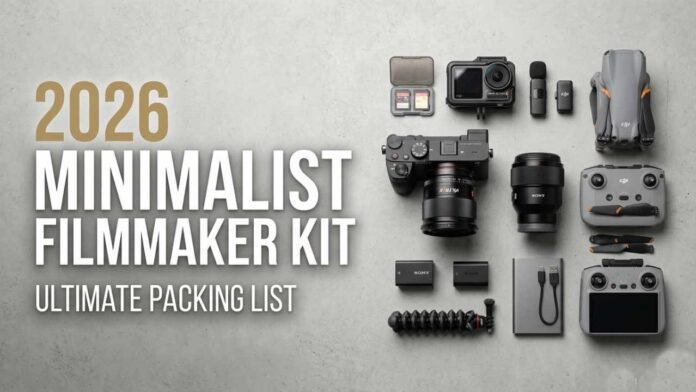
Minimalist Camera Packing List: In professional cinematography, there is a common misconception that high production value is directly proportional to the size of your equipment truck. In reality, the best camera is the one you can actually carry to the peak of a Himalayan pass or navigate through the humid, chaotic bazaar of a coastal city without sacrificing your creative energy.
Heavy rigs often lead to “creative fatigue”; when your back is aching from a 15kg pack, you start settling for the easiest shot rather than hunting for the unique angle or waiting for that perfect sliver of golden hour light. At Pankaj Sharma Films, my philosophy is built on Efficiency per Gram. I require 10-bit colour, high dynamic range, and professional-grade stabilisation, but it must all fit into a single 20L daypack. After years of field-testing gear across the diverse and often extreme terrains of India—from the sub-zero, oxygen-thin altitudes of Ladakh to the dust-heavy winds of the Thar Desert—here is my definitive minimalist packing list for $2026$.
The Full-Frame Powerhouse: Sony A7C II
For my primary “A-Cam,” the Sony A7C II is an unparalleled choice. It is the ultimate “sleeper” camera. To a bystander, its compact rangefinder-style body looks like a casual tourist camera, which is a massive tactical advantage for a documentary filmmaker. It allows me to blend into the environment and capture authentic human moments without the “intimidation factor” that usually comes with a large, matte-box-equipped cinema rig.
Why it’s in the bag: Internally, this camera is a beast, delivering breathtaking 4K 10-bit 4:2:2 internal recording. In professional post-production, this bit depth is non-negotiable. It provides the data overhead required for a sophisticated colour grading workflow. When filming a harsh midday sun over the white sands of Rann of Kutch or pulling details from the deep, velvet shadows of an ancient stepwell, 10-bit S-Log3 ensures the image doesn’t fall apart into digital noise or “banding” in the sky gradients.
The Benefit: Its AI-based real-time tracking is a lifesaver for solo shooters. Whether I’m filming a moving train from a distance or a subject walking through a crowded market, I can rely on a 99% hit rate for focus, even when shooting wide open at f/1.8 to achieve that dreamy, cinematic subject separation.
The “Two Lens, Four Focal Length” Pro Tip For Your Minimalist Camera Packing List
I have moved away from heavy, versatile zoom lenses that often compromise on maximum aperture and edge-to-edge sharpness. Instead, I rely on two specific prime lenses. However, thanks to the Super 35 (APS-C) mode on the A7C II, these two lenses actually give me the utility of four distinct focal lengths without me ever needing to change glass in a dusty or windy environment.
By utilising the 1.5times crop factor of Super 35 mode, I can instantly extend my reach while maintaining professional 4K quality, effectively protecting my sensor from the elements by keeping the lens mounted:
The Storyteller: Viltrox 16mm f/1.8. This is my primary tool for establishing the world. At its native 16 mm, it is perfect for capturing the sheer architectural scale of Indian temples. When I toggle into Super 35 mode, it becomes a 24mm equivalent, the classic documentary focal length that feels natural to the human eye. The f/1.8 aperture provides incredible low-light performance, allowing me to film handheld in dimly lit interiors where flash or external lighting would be intrusive.
The Detailer: Sony 85mm f/1.8. Native 85mm is the soul of my portrait work, offering creamy bokeh and perfect facial proportions. When I need more reach for a distant subject or an even more intimate close-up of a craftsman’s hands, I switch to Super 35 mode, which pushes the lens to approximately 130mm. This creates incredible background compression, making distant mountain peaks look massive and imposing directly behind my subjects, a look usually reserved for heavy 70-200mm lenses.
The Rugged B-Cam: DJI Osmo Action 5 Pro
There are times when the environment is simply too hostile for a full-frame Sony, think monsoon downpours in Meghalaya, underwater sequences in the Andamans, or mounting a camera to the exterior of a moving motorbike. This is where the DJI Osmo Action 5 Pro takes over.
The Technical Edge: With its 13.5 stops of dynamic range, this is the first action camera that I can confidently colour-match with my Sony A-Cam in post-production. The ability to shoot in D-Log M means my high-action B-roll doesn’t look “cheap” or over-saturated; it retains the professional, flat profile needed to maintain a consistent visual narrative across the entire film.
Reliability: The Adventure Combo is a must for travellers. Having three high-capacity batteries and a dedicated charging case ensures I can shoot an entire 12-hour day of high-frame-rate 4K without ever hunting for a power outlet in a remote village or a high-altitude campsite.
Read This: DJI Osmo Action 5 Pro: A Budget-Friendly Gem from Designinfo. in?
Aerial Cinematography: DJI Air 3 Drone
Aerial cinematography provides the “big budget” perspective that every travel film needs to establish a sense of place. I fly the DJI Air 3 because it is a professional-grade cinema tool that happens to fit in a small side-pouch of my backpack.
Focal Length Versatility: The dual-camera system is the primary reason this drone is in my kit. While most drones only offer a wide $24mm$ lens that can make landscapes look “flat,” the Air 3’s 70mm telephoto lens allows for cinematic parallax—where the foreground and background move at different speeds. This creates a majestic, three-dimensional look that makes the winding roads of the Himalayas feel truly epic. It also allows me to film wildlife or people from a distance without the loud drone noise disturbing the scene.
Audio: Capturing the Atmosphere
I firmly believe that audio is 70% of the cinematic experience. A beautiful 4K image paired with “tinny” or wind-clipped audio instantly breaks the viewer’s immersion. My setup is designed to capture high-fidelity soundscapes while remaining almost invisible to the subjects I’m filming.
Dialogue & Voiceover: I use the DJI Mic Mini. It is so incredibly light it doesn’t pull on a shirt collar, and its digital connection to my Sony camera ensures a clean signal with zero wireless “hiss.” It allows me to record crisp, professional dialogue even in the middle of a roaring Indian street market.
Environmental Soundscapes: For ambient “Foley” sounds, I keep a Boya On-Camera Mic mounted on the Sony at all times. This captures the “breath” of a location—the distant, echoing sound of temple bells, the rhythmic sizzle of street food, and the crunch of footsteps on a mountain trail. Layering these sounds in the edit is what truly transports the viewer into the story.
Read This: DJI Mic Mini Review: The Ultimate Compact Wireless Microphone for Creators
Stabilisation & Support – My Gimbal
Cinematic movement must be intentional; accidental camera shake is the quickest way to make a professional film look like a home movie. I carry three specific tools to achieve different emotional “feels” in my movement:
The Flow: Although many gimbals are available on the market, when I purchased mine, I felt that the RSC 2 Pro Combo was the perfect choice, and I never felt the need to buy another model, primarily because this gimbal is foldable. However, if I were considering buying a gimbal today, I would definitely choose the DJI RS 5; not only is it the newest model, but it also features a tracking module that can prove quite useful in a variety of different situations.
The Tripod: The Digitek BH520 is my rock-solid base. I use it for static “locked-off” shots, long-exposure timelapses of the Milky Way, and professional interview setups where I need a fluid head for smooth, controlled pans.
The Versatile Grip: The Joby GorillaPod is my “MacGyver” tool. It allows me to mount a camera where a tripod simply won’t go—wrapped around a rickshaw handle for a POV shot or balanced on an uneven river rock for a low-angle creek sequence.
Final Technical Thought
Building a minimalist camera packing list isn’t about compromise; it’s about surgical selection. It’s about knowing exactly what you need to deliver a world-class image and leaving everything else behind. This kit allows me to move faster, stay longer in the field, and ultimately, tell better stories because my mind is focused on the frame, not the weight on my shoulders.
Elevate Your Craft 🎥
Want to see the technical breakdowns, S-Log3 exposure tips, and colour grading workflows behind these tools?
YouTube: Subscribe to Pankaj Sharma Films for technical tutorials and BTS.
Instagram: Follow @PankajSharmaFilms for daily gear insights and cinematography tips.
Contact: Inquire for Collaboration & More hello@pankajsharmafilms.com
For a look at the storytelling side of our journeys, visit Sapna Sharma Films.



