

Table of Contents
The Art of Slow Travel: Vlogging to Cinematic Storytelling
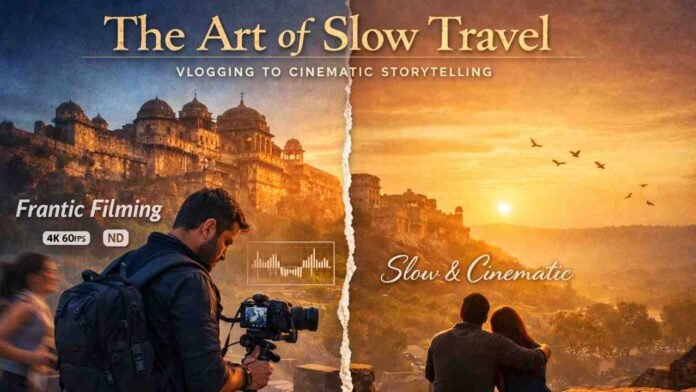
The Art of Slow Travel: I vividly remember standing in the imposing shadow of the Narsinghgarh fort a few years ago. The crisp morning light was just beginning to peak over the horizon, painting the ancient, weathered stone with a brilliant, fiery glow. The air was thick with history, a moment that felt entirely frozen in time. It was a cinematographer’s dream—except I wasn’t actually looking at it.
Instead of taking in the monumental scale of the architecture, I was staring down at the 3-inch monitor of my Sony camera. My heart rate was elevated, and my mind was racing. I was frantically checking my S-Log3 exposure waveforms, adjusting my variable ND filter, and yelling over the distant street noise to direct my wife for a fast-paced “walking transition” shot. I had given myself exactly thirty minutes to “capture” the fort before we had to sprint to the next location, rushing to the next location on our heavily packed itinerary to film the next vlog sequence.
When I returned to my hotel room that night to dump my footage onto my hard drives, my memory cards were absolutely full of perfectly exposed, 4K 60fps clips. But watching them back in the edit bay, the footage felt entirely lifeless. There was no soul, no atmosphere, no connection to the subject. It was just a superficial collection of digital trophies. I realized then that I wasn’t making films; I was just operating a camera on a treadmill.
That trip was the turning point for my entire career. It was the moment Sapna and I decided to put down the daily vlog format, step away from the exhausting viral trends, and fully embrace the art of slow travel.
Here is why changing our travel philosophy fundamentally transformed my cinematography, and why having the courage to shoot less actually makes your final films infinitely better.
The Creative Trap of the “Daily Vlog”
The modern internet algorithm loves speed. As creators, we are constantly pressured by platforms to produce hyper-edited, fast-paced videos packed with jarring speed ramps, trending audio tracks, and dizzying ten-second location jumps to retain viewer retention.
From a technical standpoint, this “run-and-gun” style is creatively exhausting. When you are rushing through a 400-year-old fort just to get a trendy transition shot, you don’t have the mental bandwidth to observe how the light interacts with the dust hanging in the air. You don’t have the time to set up a fluid head tripod for a beautifully composed, locked-off shot. Instead, you end up shooting absolutely everything at a safe, boring f/4 on a standard zoom lens with your autofocus tracking on high, just hoping you get something usable.
This approach strips the destination of its depth and turns the cinematographer into a frantic observer rather than a visual artist. Furthermore, it turns the editing process into a nightmare. You return home with terabytes of scattered, disconnected footage, a “spray and pray” methodology that lacks a cohesive narrative thread.
What is the Art of Slow Travel for a Filmmaker?
For me, the art of slow travel is a conscious rebellion against the travel bucket list.
Logistically, it means choosing to spend five days in a single, quiet village in Himachal Pradesh rather than trying to film five different famous cities in a single week. But from a cinematography perspective, it means trading breadth for profound depth.
When you stay in one location, you learn its rhythm. You learn how the light wraps around the valley at 7:00 AM versus how it casts long, dramatic shadows at 4:00 PM. It means having the luxury of time to wake up at 4:30 AM, hike to a high vantage point, and simply wait for the golden hour light to hit the valley perfectly, rather than chasing the sun. Slow travel allows you to be deeply intentional with every single frame you record.
Vlogging vs. Storytelling: The Technical Shift
When we fully embraced the art of slow travel, my entire camera rig, my shot lists, and my physical shooting style had to evolve. I stopped being a “vlog shooter” and started acting as a true “documentarian.”
Context Over Chaos: Instead of constantly filming Sapna walking and talking to the camera to explain what was happening, I started letting the environment speak for itself visually. I focused on capturing extreme, textured close-ups: an artisan’s weathered hands carving wood, the slow, rolling steam rising off a street food cart, and the intricate, hand-chiseled textures of ancient stone walls. Most importantly, I started letting my shots run for 10 to 15 seconds without cutting. When you hold a shot of a local pouring morning chai, allowing the viewer to watch the physics of the liquid and the steam dissipating, you actively force the viewer’s breathing to slow down. You allow them to truly sit within the frame.
The “Prime Only” Rule: To force myself to be more intentional, I completely stopped using heavy zoom lenses. Zoom lenses allowed me to lazily capture everything from one single standing position. I switched to a minimalist prime lens setup, specifically the Viltrox 16mm and the Sony 85mm. This forced me to physically move my body through the space to compose my shots. Zooming with your feet changes the perspective and spatial distortion of the background, creating a much more three-dimensional, cinematic look. (You can read the deep dive on this specific gear strategy in my 16mm & 85mm Travel Storytelling Guide).
Immersive Audio: Slow travel is heavily reliant on atmosphere, and audio makes up 50% of the cinematic experience. A beautiful 4K 10-bit shot is instantly ruined if it is paired with poor, windy camera audio. I stopped relying on heavy background music to drive the edit and started prioritizing high-fidelity ambient soundscapes using a dedicated on-camera shotgun mic and the DJI Mic Mini for discrete field recordings. I wanted the audience to hear the distinct crunch of the Himalayan snow underfoot, not just see the white landscape.
How to Practice – Art Of Slow Travel Cinematography
If you are an aspiring travel filmmaker feeling creatively burned out by the demands of the algorithm, here are three technical habits you can incorporate to bring the art of slow travel into your daily workflow:
The “Camera-Free” Scout
When you arrive at a breathtaking new location, leave your camera firmly zipped in your bag for the first 30 minutes. Walk around the space. Look at the exact direction of the sun. See where the shadows fall and where the highlights peak. Observe the natural movement and routines of the local people without sticking a lens in their face. By the time you finally pull your camera out, you won’t be guessing or reacting; you will know exactly which focal length you need and what specific story you are trying to tell.
Lock It Off
Put the electronic gimbal away for an entire day. While gimbals provide smooth footage, they often create a “floating,” disconnected look that removes the viewer from the reality of the scene. Mount your camera on a solid, heavy tripod and practice composing perfectly leveled, static frames. A locked-off shot of a bustling Indian market with organic, chaotic motion happening entirely inside the frame is almost always more cinematic than a dizzying hyper-lapse moving aggressively through it.
Expose for the Mood
When you slow down, you finally have the time to expose your image properly. Stop relying on Auto-ISO. Auto-exposure is a documentary filmmaker’s worst enemy because the camera constantly “hunts” to create a perfectly gray, mathematically balanced image, destroying the natural, dramatic contrast of a scene. Take the time to dial in your S-Log3 exposure manually to preserve the bright highlights in the sky and allow the deep shadows to remain truly black. (Check out my complete, technical guide on Mastering S-Log3 on the A7C II for my exact metering settings).
A Promise to the Craft
The transition from a frantic vlog shooter to a deliberate cinematic documentarian wasn’t easy. It meant capturing significantly less footage overall and letting go of viral, fast-paced editing trends. But the reward has been immeasurable. By practicing the art of slow travel, I have found a profound sense of peace and longevity behind the lens. It has prevented creative burnout. I am no longer just collecting disjointed clips for a timeline; I am preserving actual moments in time.
To our audience and fellow creators: Thank you for embracing this slower, more intentional cinematic pace with us. We promise to continue documenting the authentic, unfiltered soul of India, one quiet, perfectly exposed frame at a time.
Have you ever experienced the magic of slowing down on a shoot? Let me know your favorite slow travel memory in the comments below, and join our technical filmmaking community:
YouTube: Subscribe to PankajSharmaFilms.
Instagram: Follow PankajSharmaFilms.
Gear: Curious about the exact tools I use for this minimalist style? Read my Minimalist Camera Packing List for 2026.
For the beautiful narratives and on-camera storytelling that accompany these visuals, visit my partner in travel, Sapna Sharma Films.



