

Table of Contents
Starlink in India 2026 – Travel Filmmaking and Content Creators
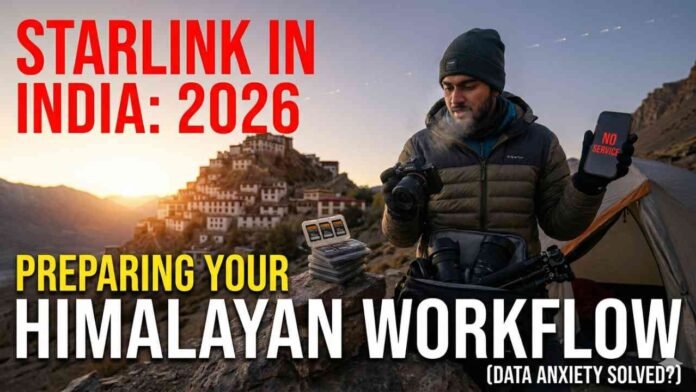
Starlink in India (2026): Picture this, you have just captured a breathtaking, 10-bit 4K sunset time-lapse over Key Monastery in Spiti Valley. The light was perfect, your exposure was flawless, and you know you just captured the hero shot of your travel documentary. But as you pack up your camera and head back to your freezing tent, a familiar dual anxiety sets in.
First, you are completely off the grid. You have gigabytes of irreplaceable footage sitting on fragile SD cards, days away from a reliable internet connection. Second, your YouTube channel and Instagram feed have been silent for a week. Your commercial client in Delhi is waiting for a progress update, and the social media algorithm is already penalizing you for “going dark.”
For years, this data anxiety and communication blackout has been the unavoidable tax of travel filmmaking and content creation in India. But the landscape is about to undergo a massive, permanent shift.
Starlink is officially coming to the Indian Himalayas. While the hardware isn’t in our backpacks just yet, the regulatory hurdles have been cleared.
Starlink’s Indian Rollout in 2026 – What’s in the News
Regulatory Clearances Secured: After years of negotiations regarding data localization and security, Starlink has successfully secured its GMPCS (Global Mobile Personal Communication by Satellite) license from the Department of Telecommunications (DoT).
Strategic Telco Partnerships: Starlink is not entering India entirely alone. To comply with local regulations and expand ground infrastructure, they are entering strategic bandwidth partnerships with major Indian telcos, including Reliance Jio and Bharti Airtel, specifically to bridge the connectivity gap in extreme terrains.
The Himalayan Focus: The initial pilot programs are heavily targeting mountainous and remote states. Agreements are already in motion with states like Meghalaya to connect off-grid regions.
The Commercial Launch: A nationwide commercial rollout for individual consumers and enterprise mobility (the portable “Roam” kits travel creators need) is officially slated for later in 2026.
Satellite internet is no longer a futuristic luxury; it is an impending critical piece of travel filmmaking infrastructure.
Instant 4K Cloud Backups (The End of SD Card Anxiety)
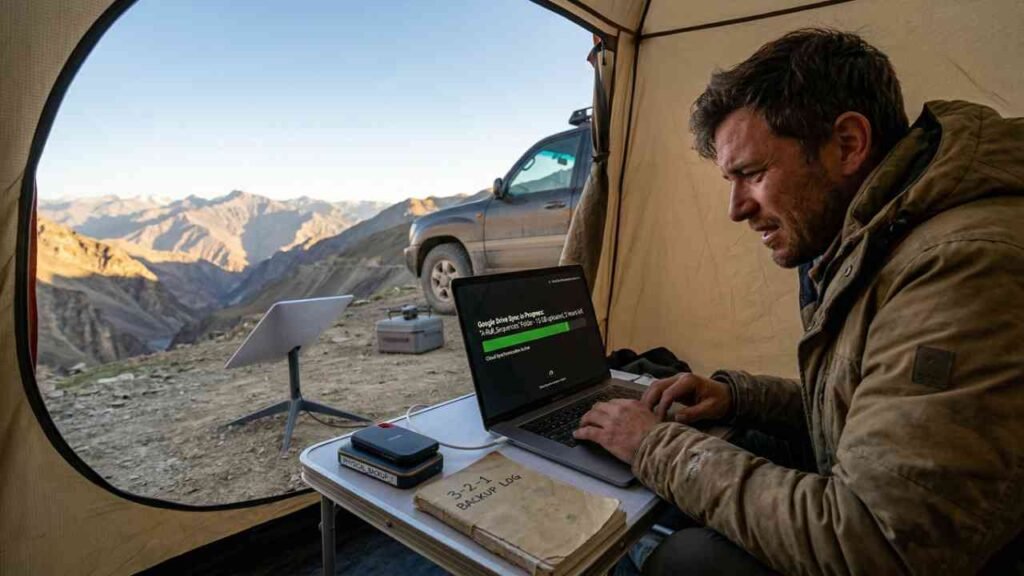
Historically, surviving rugged travel shoots meant relying heavily on the physical “3-2-1” backup rule: copying footage to multiple SSDs and hiding them in different bags. While physical backups will always be mandatory, they do not protect you against a catastrophic event like a vehicle accident or gear theft on the treacherous Leh-Manali highway.
When the Starlink Roam kits become commercially available this year, the paradigm will shift entirely for travel filmmakers. The goal is daily cloud synchronization. After dumping my camera and drone footage onto my SSDs, the new workflow will involve initiating an overnight cloud sync. Uploading critical “A-Roll” sequences directly to Google Drive or Dropbox from a tent at 14,000 feet means that if disaster strikes on the descent, the soul of your travel film is already safely archived on a server hundreds of miles away.
High-Res Live Streaming & Daily Uploads (The Content Creator’s Edge)
For travel content creators heavily reliant on audience engagement, “going dark” for two weeks in the mountains kills channel momentum.
Starlink opens up the incredible possibility of high-definition broadcasting from previously impossible locations. Imagine hosting a crisp 1080p YouTube Live stream or an Instagram Q&A directly from the freezing, turquoise shores of Pangong Tso.
Furthermore, daily vloggers will no longer have to wait until they return to civilization to upload massive video files. You can edit your 4K vlog in your homestay and let it upload to YouTube overnight. This level of immediate, high-quality engagement creates a profound, real-time connection with your audience and keeps the algorithm fed.
Remote Client Approvals (For Commercial Travel Filmmakers)
If you shoot sponsored travel campaigns for tourism boards, heritage hotels, or gear brands, you know that client communication usually dies the moment you enter the mountains. Waiting a week to return to civilization to show a client your footage is a massive financial risk. What if they needed a different angle of the product? Reshooting in the Himalayas is devastating to your profit margins.
Starlink bridges this gap perfectly. After a day of shooting, professional travel cinematographers will be able to color-grade a few select clips, render them out, and upload them to a collaborative platform like Frame.io. You can send the link to a creative director sitting in a high-rise in Mumbai, get time-stamped feedback, and receive final approval while you are still on location.
Preparing the “Proxy-First” Editing Workflow
When you shoot heavily in S-Log3 10-bit 4:2:2, your file sizes are massive. Even with low-earth-orbit satellite internet, you obviously cannot upload 500GB of raw 4K footage every night. To utilize Starlink effectively for travel filmmaking, you must master the Proxy-First Workflow right now.
Here is the exact logistical pipeline you need to start practicing:
Shoot: Capture all footage in high-bitrate 4K on the Sony A7C II.
Ingest & Proxy: Offload the footage to your MacBook Pro and immediately generate lightweight, 1080p H.265 proxies using DaVinci Resolve.
Transmit: Connect to Starlink and upload only the proxy files and the project timeline to your cloud server.
Remote Editing: Your remote editor back at the studio downloads the proxies and begins cutting the final YouTube video while you are still exploring the mountains.
Relink: When you finally return home, plug in your master SSD, relink the high-res 4K files to the finished timeline, and hit export.
The Practical Reality: Powering Starlink Off-Grid
Let’s address the technical elephant in the room: Starlink dishes require substantial AC power. How does a minimalist travel filmmaker power a satellite dish in an Indian village without electricity?
You cannot rely on tiny camera power banks. To run a Starlink setup in the remote Himalayas, travel creators will need to invest in a dedicated portable power station this year. I highly recommend a rugged, lithium-iron-phosphate (LiFePO4) power station (like an EcoFlow River 2 or Anker Solix) that provides pure sine wave AC output.
The Math: A standard Starlink dish draws about 50W to 75W once connected. A modest 500Wh power station can easily run the dish for 5 to 6 hours—more than enough time to upload proxies, backup hero shots, and publish a daily vlog before powering down to conserve energy. You then recharge the power station the next day using portable solar panels while out filming.
Final Technical Thought
The late-2026 Starlink rollout isn’t just an internet upgrade; it is a fundamental evolution in travel filmmaking insurance, content consistency, and commercial reliability. It proves to high-paying clients and your audience that you can deliver world-class content from the edge of the world. By preparing your proxy workflows and off-grid power solutions today, you ensure that the moment Starlink goes live in India, your travel channel is ready to dominate.
Master Your Filmmaking Workflow 🎥
Are you gearing up for an off-grid documentary shoot before Starlink arrives? Make sure your physical data management is bulletproof before you leave.
If you would like to watch my videos, you can do so by visiting the specific social media links provided below.
YouTube: Subscribe to PankajSharmaFilms.
Instagram: Follow PankajSharmaFilms.
Gear: Curious about the exact tools I use for this minimalist style? Read my Minimalist Camera Packing List for 2026.
For the beautiful narratives and on-camera storytelling that accompany these visuals, visit my travel partner, Sapna Sharma Films.



