

Table of Contents
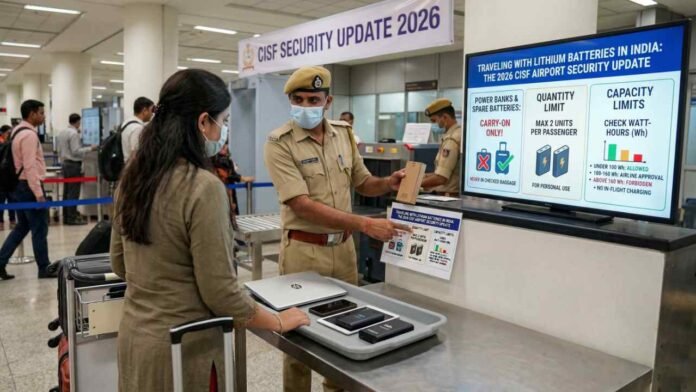
Traveling with Lithium Batteries in India: The 2026 CISF Airport Security Update
There is nothing more stressful for a solo travel filmmaker than standing at the Central Industrial Security Force (CISF) X-ray scanner at an Indian airport, watching an officer pull your heavy camera bag aside. If you are a cinematographer, your bag is likely filled with Sony NP-FZ100s, massive V-mounts, power banks, and DJI drone batteries.
If you do not know the exact legal regulations for traveling with lithium batteries in India, you risk having thousands of rupees worth of essential power gear confiscated and thrown into a plastic bin right before your flight.
In 2026, the Bureau of Civil Aviation Security (BCAS) and CISF have tightened their enforcement of hazardous materials on domestic flights. To ensure your production doesn’t get grounded before you even leave the tarmac, here is the 100% verified, mathematically precise guide to traveling with lithium batteries in India.
The Golden Rule of Traveling with Lithium Batteries in India
Before we get into the complex math of Watt-Hours (Wh), you must memorize the absolute golden rule of aviation security:
Spare lithium batteries are STRICTLY PROHIBITED in checked luggage.
When traveling with lithium batteries in India, every single spare battery, power bank, and unattached drone battery must go into your cabin baggage (carry-on). If CISF scanners detect a loose lithium battery in the cargo hold luggage, your bag will be offloaded, your lock will be broken, and the battery will be confiscated without compensation.
Understanding the Watt-Hour (Wh) Limits
The CISF does not care about the physical size or the price of your battery; they only care about its energy capacity, measured in Watt-Hours (Wh). Successfully traveling with lithium batteries in India requires you to categorize your gear into three specific zones.
The Green Zone: Under 100Wh (Allowed)
The vast majority of standard consumer camera gear falls into this category. When traveling with lithium batteries in India, you are generally allowed to carry an unlimited (but “reasonable for personal use”) number of batteries under 100Wh in your cabin baggage.
- Sony NP-FZ100 (A7C II / FX3): ~16.4Wh (Perfectly safe)
- DJI Osmo Action 5 Pro Battery: ~6.8Wh (Perfectly safe)
- DJI Air 3 Intelligent Flight Battery: ~62.6Wh (Perfectly safe)
- Standard Power Banks: A standard 20,000mAh power bank is roughly 74Wh (Perfectly safe).
The Yellow Zone: 100Wh to 160Wh (Strict Limits Apply)
This is where professional cinematographers run into major issues. High-capacity V-mount batteries and massive drone rigs fall into this tier. The 2026 regulations for traveling with lithium batteries in India state that batteries between 100Wh and 160Wh require airline approval, and you are strictly limited to exactly TWO (2) spare batteries per passenger.
- 98Wh / 150Wh V-Mount Batteries: If you use a 150Wh V-mount for your lighting or cinema rig, you can only carry a maximum of two spares.
- Airline Approval: In practice at Indian airports like DEL or BOM, “airline approval” means you must declare these two batteries at the check-in counter before proceeding to CISF security. The airline agent will inspect them and give you verbal clearance for your cabin bag.
The Red Zone: Over 160Wh (Prohibited)
Do not attempt to fly with these. When traveling with lithium batteries in India, any battery exceeding 160Wh is banned from both cabin and checked baggage on commercial passenger flights.
Massive 190Wh or 290Wh V-Mounts: These must be shipped to your location via dedicated surface cargo ahead of time. If you bring them to the airport, CISF will confiscate them immediately.
How to Calculate Watt-Hours (The Formula)
Sometimes, cheaper batteries only list Milliampere-hours (mAh) and Volts (V), omitting the Wh rating. If the label doesn’t clearly state the Wh, CISF officers are instructed to reject it. You must do the math yourself and label it clearly if necessary.
The formula for traveling with lithium batteries in India is: (mAh / 1000) × V = Wh
Example for a power bank:
- Capacity: 24,000mAh
- Voltage: 5V
- Calculation: (24,000 / 1000) × 5 = 120Wh (This falls into the Yellow Zone!)
The 2026 CISF Security Checkpoint Protocol
Knowing the capacity limits is only half the battle. How you present your gear at the X-ray scanner dictates how fast you clear security. To master the art of traveling with lithium batteries in India, follow this CISF protocol:
The Tray Separation: CISF mandates that high-density electronics must not overlap on the X-ray. Remove all V-mounts, power banks, and heavy drone batteries from your camera bag and place them flat in a separate tray. If they are stacked inside your bag, they look like a solid, opaque mass on the scanner, triggering an immediate manual search.
Terminal Protection: Aviation rules require that battery terminals be protected from short circuits. When traveling with lithium batteries in India, either keep the batteries in their original retail packaging, place tape over the metal contact points, or put each battery in its own separate Ziploc bag.
The LiPo Safe Bag Rule: While not strictly written in BCAS law, many CISF officers at major hubs (like BLR or BLR) now expect drone Lithium Polymer (LiPo) batteries to be stored in fire-retardant “LiPo Safe Bags.” Spending ₹800 on a LiPo bag shows the officer you are a professional who respects safety protocols, virtually guaranteeing a smooth security check.
Final Technical Summary
Your camera gear is useless if you cannot power it. By understanding the strict division between 100Wh and 160Wh, packing all spares in your carry-on, and investing in terminal protection, you completely eliminate the anxiety of airport security. Mastering the logistics of traveling with lithium batteries in India is what separates the prepared professional from the amateur.
Upgrade Your Travel Logistics 🎥
Are you preparing for an intense documentary shoot across India? Make sure your kit is perfectly optimized for domestic flights.
Read: My 2026 Minimalist Camera Packing List
If you would like to watch my videos, you can do so by visiting the specific social media links provided below.
YouTube: Subscribe to PankajSharmaFilms.
Instagram: Follow PankajSharmaFilms.



